Stones That Remain
The sustainable art of building dry stone walls without machines or mortar has been a tradition in the Mournes for over four thousand years. Ulster-Scot stonemason, Mark Hanna reveals how this intricate craft inspires him to write poetry about the beauty and strength of the granite walls.
Formerly a builder by trade, Mark Hanna has honed the ancient craft of dry stone wall building by embracing the original techniques employed over centuries. Handed down over generations, this long-standing rural farming tradition dates back to the Neolithic Period of more than 5,000 years ago. Always recognised as a highly skilled job, there was a time professional dry stone wallers travelled throughout the country, as well as over and back from Ireland to England, Scotland and Wales. Many walls on estates and larger farms were built by these skilled craft workers, extending as far back as the medieval period.
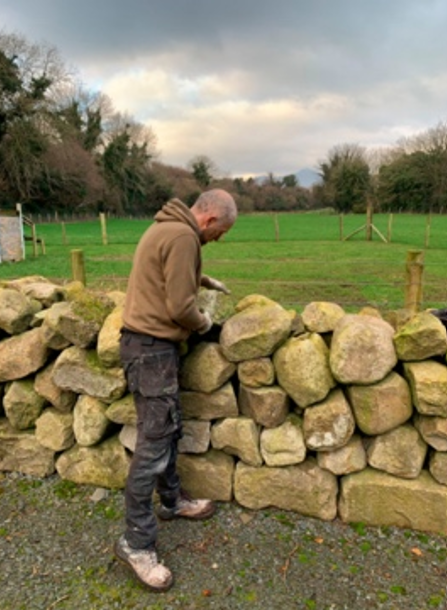
In single dry stone walls, every stone spans the full width of the wall. They do not have a core. These walls are often built at a great pace and with a strong understanding of how the stones will sit well together.
There is an art to stacking stone on stone to “coggle and skim the skelfs and spalls” one by one, which Mark calls “early Irish Lego”. It’s a surprisingly sustainable building method, the walls develop their own ecosystems of insects and ivy and the gaps between stones not only allow wind through, he said, but let “rabbits and badgers pass through while keeping the cows in the field”. The largest stones are always at the base of the wall because, as well as being impractical to lift, using them higher up would destabilise the wall greatly. Stones get gradually smaller as the wall goes up.
In County Down, Mark has restored original dry stone walls back to their mid-18th century glory, with granite direct from the Mourne mountains, and created new boundaries. Stone-wall building is inherent to life in the Mournes, where the renowned 35-kilometer Mourne Wall remains the longest continuous length of dry-stone wall in Britain and Ireland. Mark has gained an appreciation for the beauty, physical hard graft, judgement and precision required of this craft and has turned to poetry to capture his love of working the land.